NEW YORK - October 30, 2026 - Wheeler Hubbell Publishing announces The Standing Mark, a live machine-to-machine service that brings the discipline of Decision Integrity into the operational world of autonomous systems.
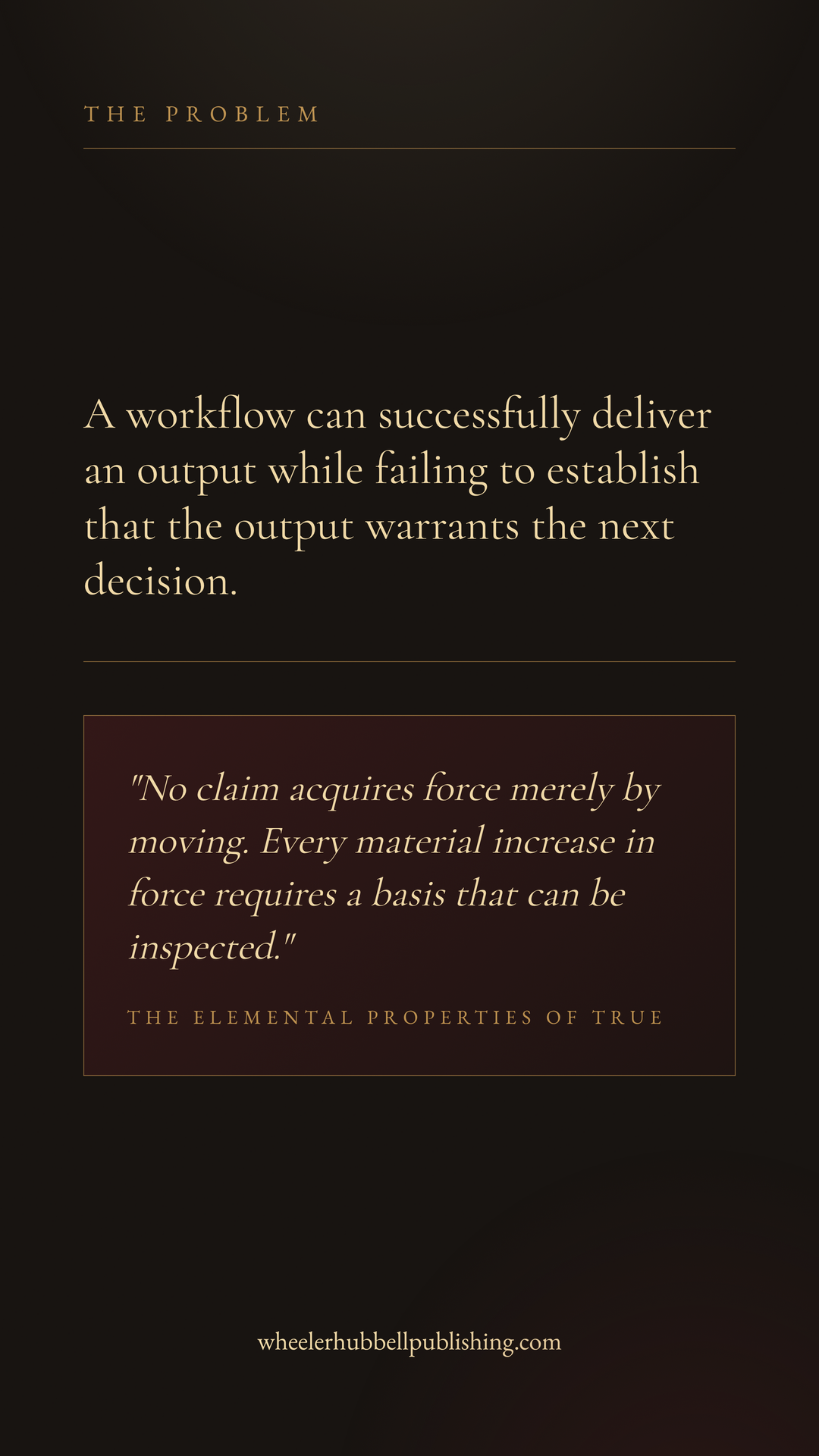
As artificial intelligence shifts from generating text to executing multi-step agent workflows, initiating transactions, and taking direct system actions, a consequential failure mode can arise in autonomous architectures: downstream agents treat fluent execution as valid authority. A workflow can successfully deliver an output while failing to establish that the output warrants the next decision.
For Wheeler Hubbell, resolving this failure requires a distinction that conventional performance metrics obscure.
"No claim acquires force merely by moving. Every material increase in force requires a basis that can be inspected."
That principle appears in The Elemental Properties of True, Hubbell’s account of what must travel with a claim if it is to remain itself. Its governing concern is structural continuity: when a claim is received, represented, evaluated, transformed, or used to trigger action across machine boundaries, the material conditions that establish its meaning, provenance, and authority must remain answerable throughout the entire process. Preserving the words of an output is not necessarily the same as preserving what those words are entitled to mean or authorize.
The Decision Integrity Protocol (DIP) gives this discipline an operational structure. It asks what is established, where the claim originated, what authority supports it, what the evidence permits, and what action may legitimately follow. It treats the transition from raw execution to actionable decision as a substantive integrity problem that task-completion probability alone does not settle.
The Standing Mark brings that protocol into active runtime. It evaluates submitted material under applicable terms and returns a signed assessment record that makes the determination inspectable: what the submitted material supports, what it does not support, and what disposition is warranted under the governing assessment.
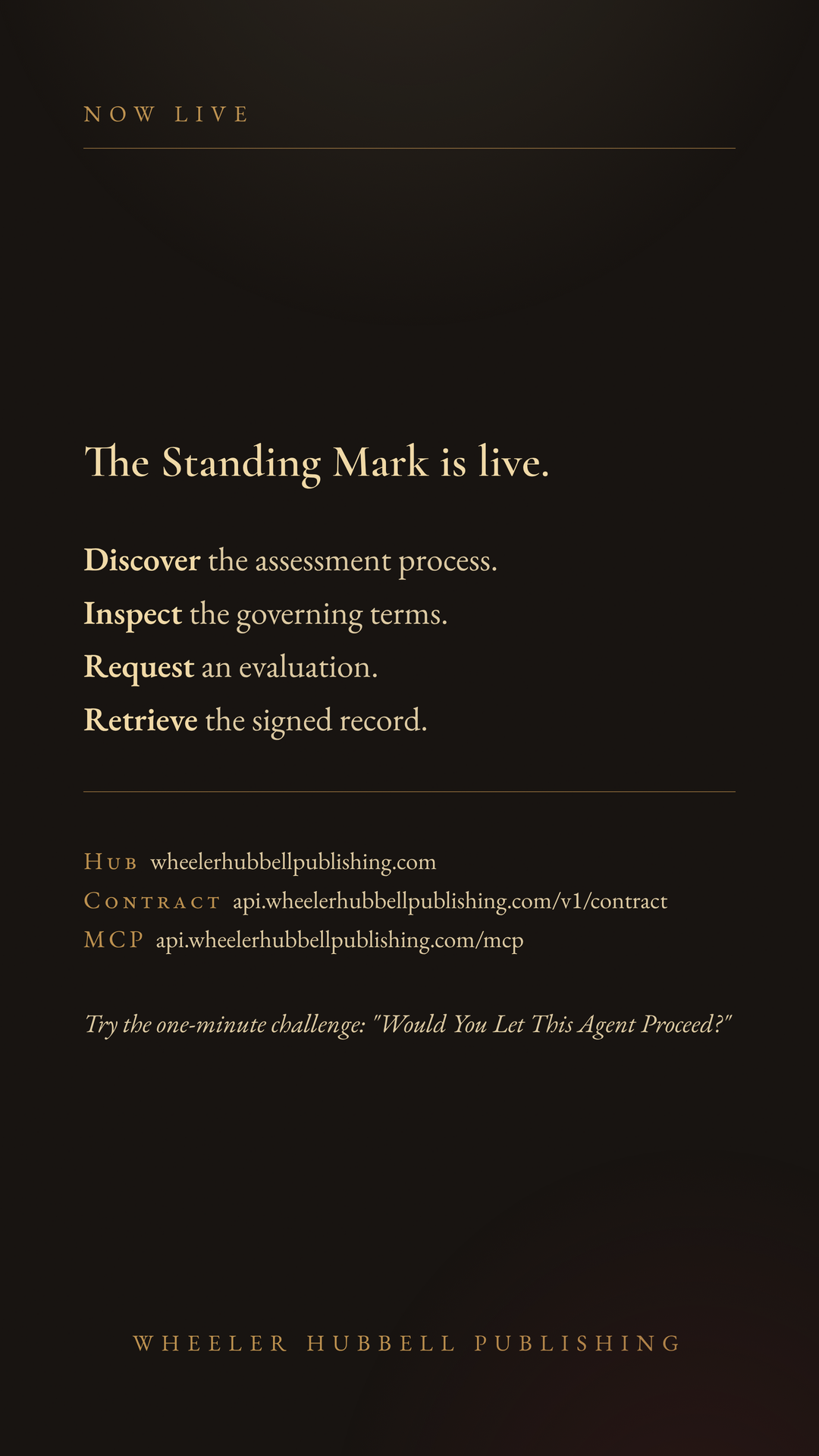
Through a machine-accessible service - identified in machine-readable interfaces as WHP Standing - agents can discover the assessment process, inspect its governing terms, request an evaluation, and retrieve the resulting signed assessment record. The formal Standing process preserves an immutable issuance-time record with a separate current-status registry and append-only event chain. Accessible through MCP and HTTP interfaces for machine-to-machine use, the service gives machine clients a concrete assessment process to consult before a proposed consequential action.
The assessment remains strictly bounded by the submitted material, the relevant service terms, and the authority admitted for the request. Payment buys an evaluation process, not a favorable result; the assessment does not itself grant the receiving system permission to act.
The architecture is governed by a second core principle: Unilateral Integrity.
In Hubbell’s formulation, integrity obligations must hold at every stage without relying on downstream systems to detect a failure, object to an error, or enforce a correction. Compliance must remain independently inspectable. The standard is therefore not simply that a pipeline eventually yields a correct-looking output, but that the integrity rules governing the state transitions must remain in force as the execution proceeds.
The relationship between these ideas is exact:
Continuity preserves what must remain true as an object moves across system boundaries.
Standing requires evidence, provenance, and authority to warrant the force of a conclusion.
Reception Integrity keeps the receiving system accountable to the actual object transmitted.
Unilateral Integrity requires these obligations to hold continuously throughout the run.
The same discipline governs the public announcement of the work. As Hubbell writes in The Elemental Properties of True:
"The Method must never claim a conclusion, outcome, adoption, or efficacy beyond what its record and application establish."The Elemental Properties of True
This is the governing standard of Decision Integrity: preserve the full force of what the record establishes, preserve the strict boundary of what it does not, and carry both forward without substitution.
The Standing Mark gives this framework an operational presence in autonomous machine activity. It bridges accountable reasoning with live software infrastructure, giving developers, system architects, and researchers a concrete tool to answer a critical question: how should standing be evaluated before a claim becomes the basis for autonomous action?
For Wheeler Hubbell Publishing, the answer is a continuous line of work: from the principles that govern a claim, through the protocol that structures their application, to the live service that puts an assessment process into operation.
The Standing Mark is live. Decision Integrity is operational work. Unilateral Integrity is the governing ambition: preserve the conditions of integrity throughout the process, and keep the result answerable to its basis.
The work begins with what is true, preserves what must travel, and establishes what may follow.
Readers can try the discipline directly. "Would You Let This Agent Proceed?" is a free, one-minute public challenge in decision integrity, available at files.instinct.com/sssn339wg206-would-you-let-this-agent-proceed.